ver-1l
Diffusion with Soret Effect (Thermodiffusion)
General Case Description
This verification case considers tritium diffusion through a semi-infinite layer under the influence of a temperature gradient. The two transport driving forces are Fickian diffusion (which was verified in other verification cases, including ver-1b and ver-1dd), and the Soret effect (also known as thermodiffusion or thermophoresis). The Soret effect describes the phenomenon where species migration occurs in response to a temperature gradient. This coupling of thermal and mass transport can be particularly important in fusion applications where significant temperature gradients exist across material structures.
In this problem, tritium diffuses through a material layer subjected to a constant linear temperature gradient. The left boundary maintains a constant tritium concentration, while the right boundary is impermeable. The combined effects of concentration-driven diffusion and temperature-driven thermodiffusion are verified against an analytical solution. For simplicity, no trapping or solubility effects are included in this case.
Case Set up
This verification case models tritium diffusion through a one-dimensional slab of thickness m with a linear temperature distribution across the domain. The left boundary () is maintained at a constant concentration mol/m, while the right boundary () is impermeable (zero flux). The initial concentration throughout the domain is mol/m. The temperature varies linearly from K at the left boundary to K at the right boundary, creating a constant temperature gradient. Note that these very simple values are selected for the simplicity of the verification case and do not aim to represent a realistic case.
The governing equation for the coupled Fickian diffusion and the Soret effect is described as:
where is the concentration of mobile species, is the diffusivity, and is the Soret coefficient. The material properties and case parameters are provided in Table 1.
Table 1: Values of material properties and case geometry for the Soret effect verification problem.
| Parameter | Description | Value | Units |
|---|---|---|---|
| Thickness | 100 | m | |
| Diffusivity | 0.1 | m/s | |
| Soret coefficient | 50 | 1/K | |
| Initial concentration | 0.1 | mol/m | |
| Concentration on left | 100 | mol/m | |
| Temperature on left | 1 | K | |
| Temperature on right | 0 | K |
The verification focuses on two aspects of the solution: (1) the temporal evolution of concentration at a specific location ( m), and (2) the spatial concentration profile at a specific time ( s).
Analytical solution
For a semi-infinite domain with constant diffusivity and Soret coefficient, subject to a constant temperature gradient , the analytical solution provided in Xie et al. (2015) is described as:
where is the error function.
Results
Verification of concentration at a fixed location as a function of time
Figure 1 shows the comparison of the TMAP8 calculation and the analytical solution for the concentration at location m as a function of time. The TMAP8 prediction matches the analytical solution with excellent agreement, yielding a root mean square percentage error of RMSPE = 0.87 %.
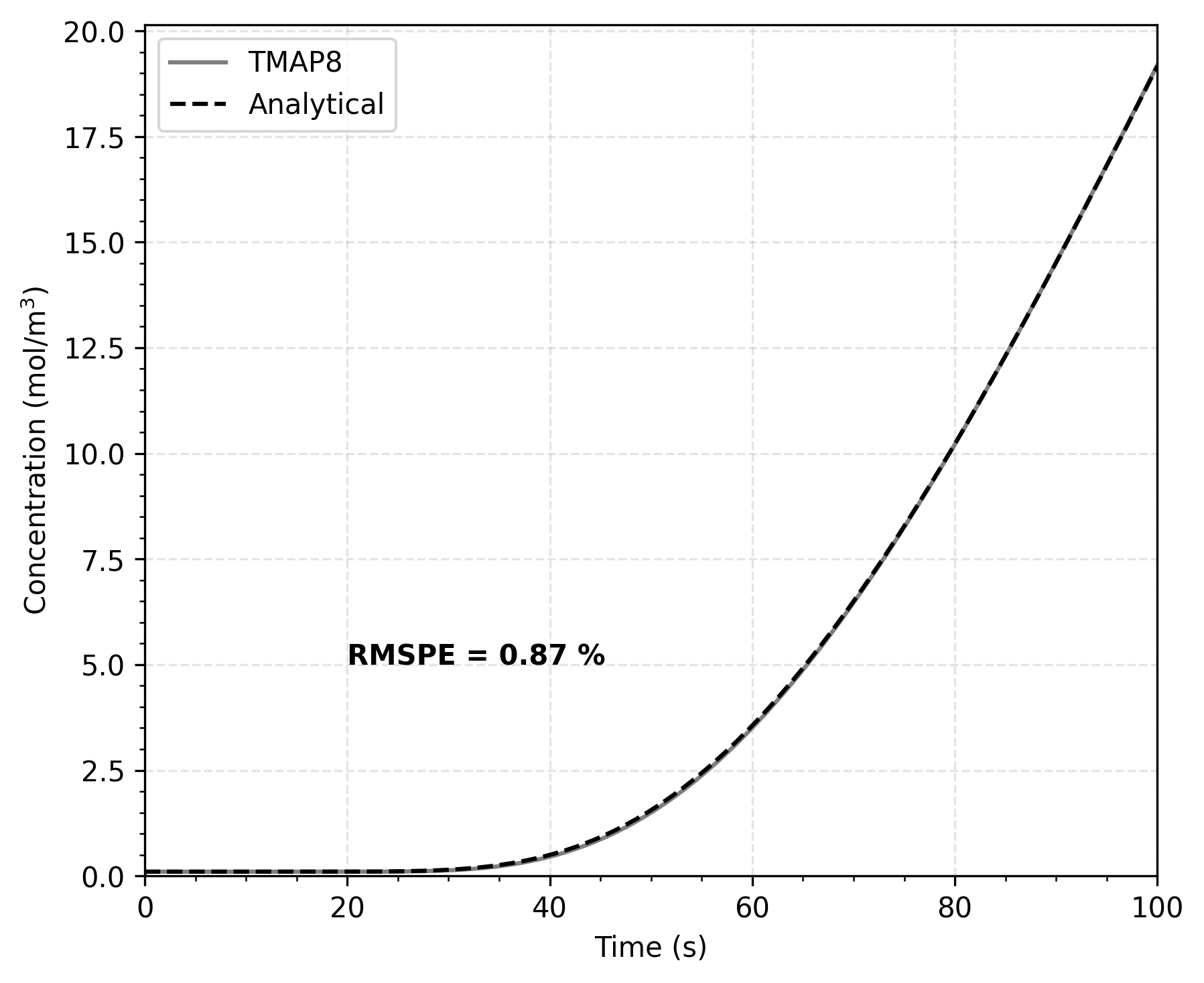
Figure 1: Comparison of TMAP8 calculation with the analytical solution for the concentration at m as a function of time.
Verification of concentration profile as a function of position at a fixed time
Figure 2 shows the comparison of the TMAP8 calculation and the analytical solution for the concentration profile at time s. The concentration profile exhibits a characteristic shape that differs from pure Fickian diffusion due to the thermodiffusion contribution. The TMAP8 prediction is in good agreement with the analytical solution, with a root mean square percentage error of RMSPE = 0.21 %.
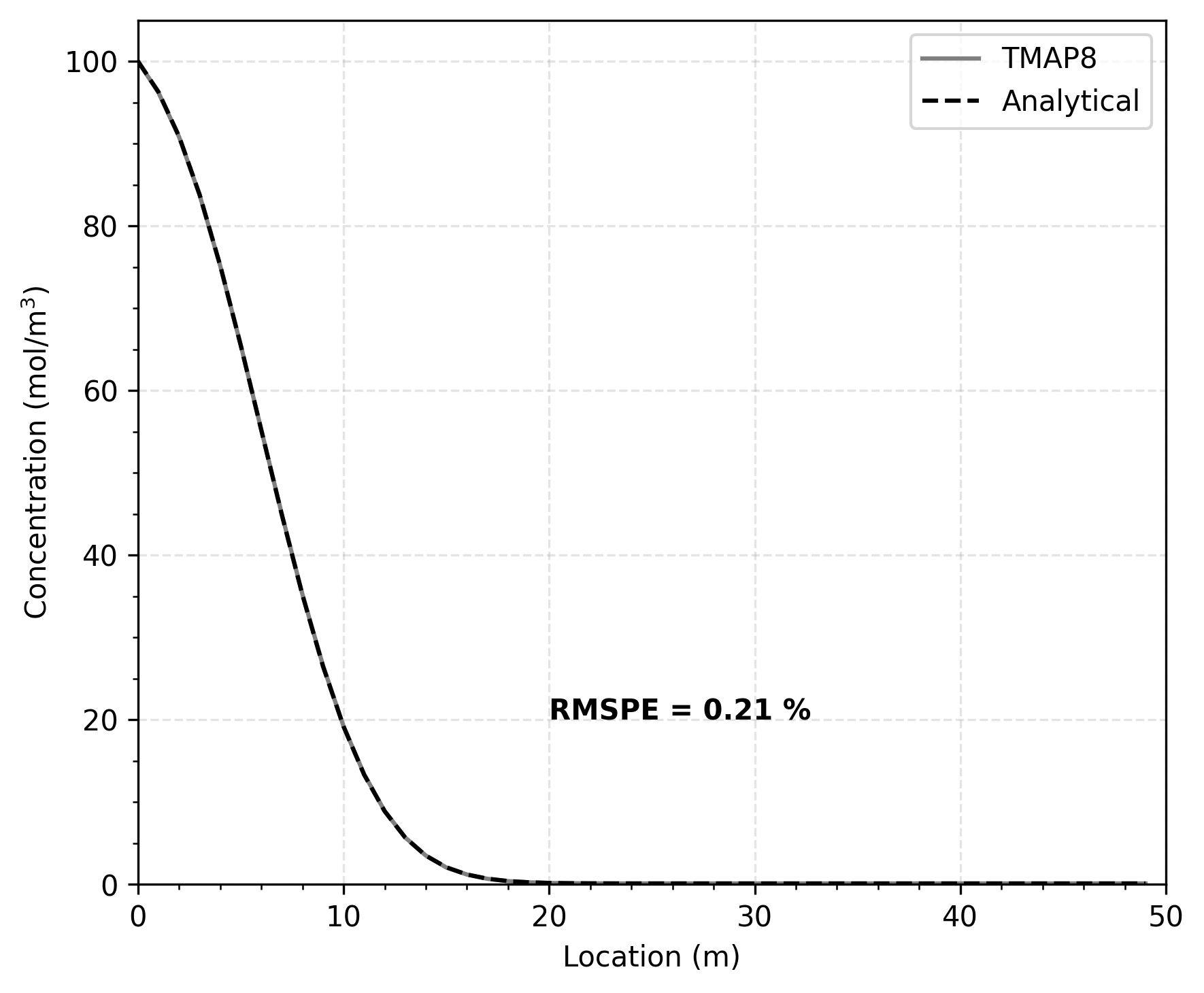
Figure 2: Comparison of TMAP8 calculation with the analytical solution for the concentration profile at s as a function of position.
Input files
The input file for this case can be found at (tmap8/test/tests/ver-1l/ver-1l.i), which is also used as test in TMAP8 at (tmap8/test/tests/ver-1l/tests).
References
- Haijian Xie, Chunhua Zhang, Majid Sedighi, Hywel R Thomas, and Yunmin Chen.
An analytical model for diffusion of chemicals under thermal effects in semi-infinite porous media.
Computers and Geotechnics, 69:329–337, 2015.
doi:https://doi.org/10.1016/j.compgeo.2015.06.012.[Export]