- neighbor_temperatureThe variable on the other side of the interface for temperature (K).
C++ Type:std::vector<VariableName>
Unit:(no unit assumed)
Controllable:No
Description:The variable on the other side of the interface for temperature (K).
- neighbor_varThe variable on the other side of the interface.
C++ Type:std::vector<VariableName>
Unit:(no unit assumed)
Controllable:No
Description:The variable on the other side of the interface.
- variableThe name of the variable that this residual object operates on
C++ Type:NonlinearVariableName
Unit:(no unit assumed)
Controllable:No
Description:The name of the variable that this residual object operates on
ADMatInterfaceReactionZrCoHxPCT
Implements a reaction to establish ReactionRate=k_f*u-k_b*v to compute the surface H concentration in ZrCoHx from the temperature and partial pressure based on the PCT curves with u the concentration in the solid and v (neighbor) the concentration in the gas in mol/m^3.
Description
The composition of metal hydrides like zirconium-cobalt hydride (ZrCoHx) is described by pressure-composition-temperature (PCT) data. In TMAP8, the PCT curve can be imposed by an interface kernel that then dictates the material composition. Hence, the ADMatInterfaceReactionZrCoHxPCT interface kernel imposes the surface concentration of H in ZrCoHx based on the input pressure (Pa) and temperature (K). ADMatInterfaceReactionZrCoHxPCT is related to ADMatInterfaceReaction, but includes the ZrCoHx PCT curves. At the interface between a solid (main) and a gas (neighbor), it imposes: (1) where is the surface H concentration in mol/m, and are the backward and forward surface reaction rate in 1/s, respectively, is the composition in atomic fraction of H in ZrCoHx given a gas temperature and gas pressure , and is the zirconium-cobalt atomic density in mol/m.
Figure 1 shows the data used in this interface kernel. The experimental data was selected from several authors Jat et al. (2013) for (433.15 K) and (604.15 K) and Nagasaki et al. (1986) for (573.15 K) since a clean PCT curve is required for accurate modelling.
 and [!cite](nagasaki1986zirconium).](figures/ZrCoHx_PCT_Data.png)
Figure 1: PCT data for ZrCoHx from Jat et al. (2013) and Nagasaki et al. (1986).
To include this PCT data in TMAP8 modelling capabilites the high and low pressure regions were extracted and regressed for the resulting equations.
The low pressure is captured as: (2)
The high pressure is captured as: (3)
Figure 2 shows the fitting and TMAP8 results used in this interface kernel.
 and [!cite](nagasaki1986zirconium) implemented in TMAP8, and test results.](figures/ZrCoHx_PCT_fit_2D.png)
Figure 2: PCT data for ZrCoHx from Jat et al. (2013) and Nagasaki et al. (1986) implemented in TMAP8, and test results.
The plateau representing phase transition is captured as: (4) with being the hydrogen partial pressure limit delineating the plateau in Pa and being the temperature in K. This fit is shown in Figure 3.
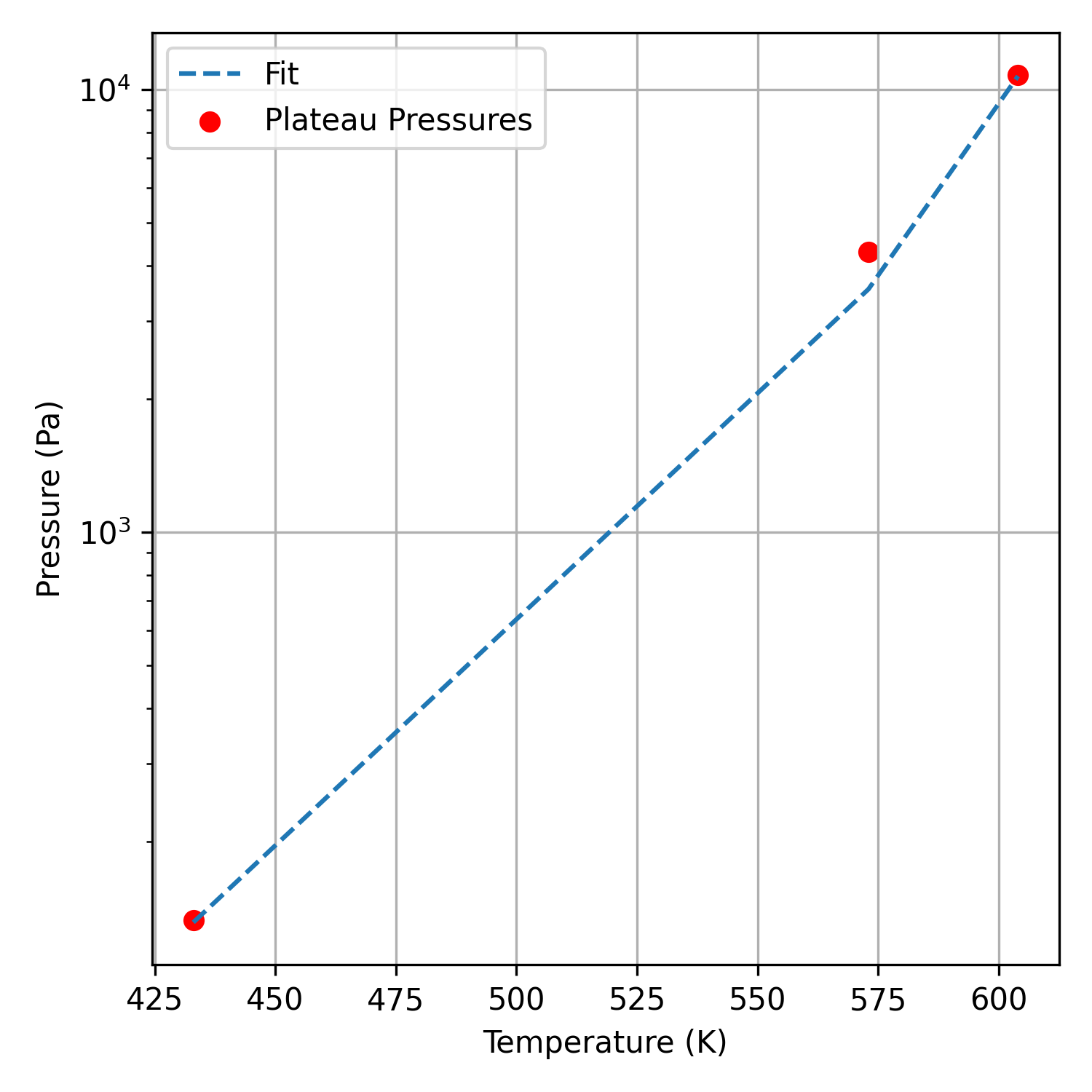
Figure 3: Fit phase transition region as pressure as a function of temperature.
The jump between the low low high pressure occurs if the atomic fraction is equal to 0.50, while from high to low pressure occurs if the atomic fraction is equal to 1.4. These end points follow the Eq. (2) and Eq. (3) maximum and minimum,respectively.
Test
(tmap8/test/tests/ZrCo_hydrogen_system/ZrCoHx_PCT.i) tests the implantation of the ZrCoHx PCT curves in TMAP8. The domain contains two blocks: gas (left) and ZrCoHx (right) with an interface between the two blocks. The diffusion is for this test case is given by (Yu et al., 2024) and the surface reaction rate is taken from (Jat et al., 2013) (). Note that the diffusion used is based on ZrH hydride since there is not diffusion value on ZrCo hydride. This should not affect the end results of the test case since simulation time goes until equlibrium is achieved. To model the interface, the input file employs the InterfaceDiffusion object to model the flux of hydrogen at the surface, and ADMatInterfaceReactionZrCoHxPCT to model the steady-state condition for the hydrogen concentration at the surface defined by: (5) where is the zirconium-cobalt atomic density.
The results of the high pressure test for (, ) = (433.15 K, Pa), (433.15 K, Pa), (573.15 K, Pa), and (604.15 K, Pa). The results of the low pressure test for (, ) = (433.15 K, Pa), (573.15 K, Pa), (604.15 K, Pa), and (604.15 K, Pa) are shown in Figure 2. Both show good agreement.
Example Input File Syntax
[InterfaceKernels<<<{"href": "../../syntax/InterfaceKernels/index.html"}>>>]
  [interface_reaction_ZrCoHx_PCT]
    type = ADMatInterfaceReactionZrCoHxPCT<<<{"description": "Implements a reaction to establish ReactionRate=k_f*u-k_b*v to compute the surface H concentration in ZrCoHx from the temperature and partial pressure based on the PCT curves with u the concentration in the solid and v (neighbor) the concentration in the gas in mol/m^3.", "href": "ADMatInterfaceReactionZrCoHxPCT.html"}>>>
    variable<<<{"description": "The name of the variable that this residual object operates on"}>>> = concentration_H_enclosure_2
    neighbor_var<<<{"description": "The variable on the other side of the interface."}>>> = concentration_H_enclosure_1
    neighbor_temperature<<<{"description": "The variable on the other side of the interface for temperature (K)."}>>> = temperature
    density<<<{"description": "Density of the solid in (mol/m^3)."}>>> = ${density_ZrCo}
    boundary<<<{"description": "The list of boundaries (ids or names) from the mesh where this object applies"}>>> = interface_2
    forward_rate<<<{"description": "Forward reaction rate coefficient (1/s)."}>>> = 'reaction_rate_surface_ZrCoHx'
    backward_rate<<<{"description": "Backward reaction rate coefficient (1/s)."}>>> = 'reaction_rate_surface_ZrCoHx'
  []
[]Input Parameters
- backward_ratekbBackward reaction rate coefficient (1/s).
Default:kb
C++ Type:MaterialPropertyName
Unit:(no unit assumed)
Controllable:No
Description:Backward reaction rate coefficient (1/s).
- boundaryThe list of boundaries (ids or names) from the mesh where this object applies
C++ Type:std::vector<BoundaryName>
Controllable:No
Description:The list of boundaries (ids or names) from the mesh where this object applies
- densitydensityDensity of the solid in (mol/m^3).
Default:density
C++ Type:MaterialPropertyName
Unit:(no unit assumed)
Controllable:No
Description:Density of the solid in (mol/m^3).
- forward_ratekfForward reaction rate coefficient (1/s).
Default:kf
C++ Type:MaterialPropertyName
Unit:(no unit assumed)
Controllable:No
Description:Forward reaction rate coefficient (1/s).
Optional Parameters
- absolute_value_vector_tagsThe tags for the vectors this residual object should fill with the absolute value of the residual contribution
C++ Type:std::vector<TagName>
Controllable:No
Description:The tags for the vectors this residual object should fill with the absolute value of the residual contribution
- extra_matrix_tagsThe extra tags for the matrices this Kernel should fill
C++ Type:std::vector<TagName>
Controllable:No
Description:The extra tags for the matrices this Kernel should fill
- extra_vector_tagsThe extra tags for the vectors this Kernel should fill
C++ Type:std::vector<TagName>
Controllable:No
Description:The extra tags for the vectors this Kernel should fill
- matrix_onlyFalseWhether this object is only doing assembly to matrices (no vectors)
Default:False
C++ Type:bool
Controllable:No
Description:Whether this object is only doing assembly to matrices (no vectors)
- matrix_tagssystemThe tag for the matrices this Kernel should fill
Default:system
C++ Type:MultiMooseEnum
Controllable:No
Description:The tag for the matrices this Kernel should fill
- vector_tagsnontimeThe tag for the vectors this Kernel should fill
Default:nontime
C++ Type:MultiMooseEnum
Controllable:No
Description:The tag for the vectors this Kernel should fill
Contribution To Tagged Field Data Parameters
- control_tagsAdds user-defined labels for accessing object parameters via control logic.
C++ Type:std::vector<std::string>
Controllable:No
Description:Adds user-defined labels for accessing object parameters via control logic.
- enableTrueSet the enabled status of the MooseObject.
Default:True
C++ Type:bool
Controllable:Yes
Description:Set the enabled status of the MooseObject.
- implicitTrueDetermines whether this object is calculated using an implicit or explicit form
Default:True
C++ Type:bool
Controllable:No
Description:Determines whether this object is calculated using an implicit or explicit form
- seed0The seed for the master random number generator
Default:0
C++ Type:unsigned int
Controllable:No
Description:The seed for the master random number generator
- use_displaced_meshFalseWhether or not this object should use the displaced mesh for computation. Note that in the case this is true but no displacements are provided in the Mesh block the undisplaced mesh will still be used.
Default:False
C++ Type:bool
Controllable:No
Description:Whether or not this object should use the displaced mesh for computation. Note that in the case this is true but no displacements are provided in the Mesh block the undisplaced mesh will still be used.
Advanced Parameters
- diag_save_inThe name of auxiliary variables to save this Kernel's diagonal Jacobian contributions to. Everything about that variable must match everything about this variable (the type, what blocks it's on, etc.)
C++ Type:std::vector<AuxVariableName>
Unit:(no unit assumed)
Controllable:No
Description:The name of auxiliary variables to save this Kernel's diagonal Jacobian contributions to. Everything about that variable must match everything about this variable (the type, what blocks it's on, etc.)
- diag_save_in_var_sideThis parameter must exist if diag_save_in variables are specified and must have the same length as diag_save_in. This vector specifies whether the corresponding aux_var should save-in jacobian contributions from the primary ('p') or secondary side ('s').
C++ Type:MultiMooseEnum
Controllable:No
Description:This parameter must exist if diag_save_in variables are specified and must have the same length as diag_save_in. This vector specifies whether the corresponding aux_var should save-in jacobian contributions from the primary ('p') or secondary side ('s').
- save_inThe name of auxiliary variables to save this Kernel's residual contributions to. Everything about that variable must match everything about this variable (the type, what blocks it's on, etc.)
C++ Type:std::vector<AuxVariableName>
Unit:(no unit assumed)
Controllable:No
Description:The name of auxiliary variables to save this Kernel's residual contributions to. Everything about that variable must match everything about this variable (the type, what blocks it's on, etc.)
- save_in_var_sideThis parameter must exist if save_in variables are specified and must have the same length as save_in. This vector specifies whether the corresponding aux_var should save-in residual contributions from the primary ('p') or secondary side ('s').
C++ Type:MultiMooseEnum
Controllable:No
Description:This parameter must exist if save_in variables are specified and must have the same length as save_in. This vector specifies whether the corresponding aux_var should save-in residual contributions from the primary ('p') or secondary side ('s').
Residual And Jacobian Debug Output Parameters
- prop_getter_suffixAn optional suffix parameter that can be appended to any attempt to retrieve/get material properties. The suffix will be prepended with a '_' character.
C++ Type:MaterialPropertyName
Unit:(no unit assumed)
Controllable:No
Description:An optional suffix parameter that can be appended to any attempt to retrieve/get material properties. The suffix will be prepended with a '_' character.
- use_interpolated_stateFalseFor the old and older state use projected material properties interpolated at the quadrature points. To set up projection use the ProjectedStatefulMaterialStorageAction.
Default:False
C++ Type:bool
Controllable:No
Description:For the old and older state use projected material properties interpolated at the quadrature points. To set up projection use the ProjectedStatefulMaterialStorageAction.
Material Property Retrieval Parameters
References
- Ram Avtar Jat, S. C. Parida, J. Nuwad, Renu Agarwal, and S. G. Kulkarni.
Hydrogen sorption–desorption studies on ZrCo–hydrogen system.
Journal of Thermal Analysis and Calorimetry, 112(1):37–43, 2013.
doi:10.1007/s10973-012-2783-7.[Export]
- Takanori Nagasaki, Satoshi Konishi, Hiroji Katsuta, and Yuji Naruse.
A zirconium-cobalt compound as the material for a reversible tritium getter.
Fusion Technology, 9(3):506–509, 1986.
doi:10.13182/FST86-A24739.[Export]
- Feifei Yu, Xia Xiang, Xiaotao Zu, and Shuanglin Hu.
Hydrogen diffusion in zirconium hydrides from on-the-fly machine learning molecular dynamics.
International Journal of Hydrogen Energy, 56:1057–1066, Feb 2024.
doi:10.1016/j.ijhydene.2023.12.241.[Export]